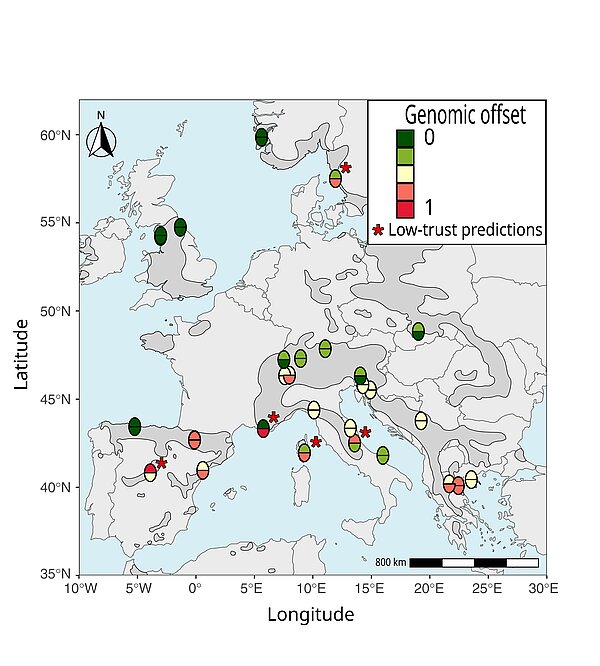
Genomic tools shed light on the climate risks facing the English yew
Climate maladaptation risk is rising for many species, including long-lived trees, and assessing this issue remains a critical frontier in conservation genetics. A new study demonstrates how genomic offset approaches, which leverage genotype-environment associations, can help predict maladaptation to future climate.
The research focused on the English yew (Taxus baccata), a declining tree with a fragmented distribution across Europe, the Atlas Mountains, and the Near East. Scientists sampled 475 trees from 29 European populations, analyzing 8,616 SNPs to uncover patterns of adaptation.
Results revealed evidence of local climate adaptation, with climate explaining 18.8% of genetic variance and 100 unlinked climate-associated loci identified through genotype-environment associations. Crucially, genomic offset predictions were successfully validated against phenotypic traits measured in 26 populations grown under common garden conditions, supporting the accuracy of the predictions. Results suggest that Mediterranean and high-elevation English yew populations face higher vulnerability to climate change than low-elevation Atlantic and continental populations.
The study also underscored several challenges for future work. For instance, variability in local adaptation across populations can impact the predictions, highlighting the need to refine genomic offset methods with additional statistics and data sources.
By integrating genomic and phenotypic insights, this study advances the practical application of genomic offsets in conservation genetics and provides a foundation for more accurate assessments of climate vulnerability in forest species.
Read the full paper: https://doi.org/10.1111/eva.70160